
Ihsan (Excellence) in the Life of Prophet Abraham
The reward for the Ihsan (excellence) of our Master Abraham—in his deeds, his words, his spiritual states, and his fulfillment of everything Allah entrusted him with—was that Allah bestowed His divine favor upon him and made him a beacon of goodness.
Muhammad Abd-Almonim
5/17/20264 min read
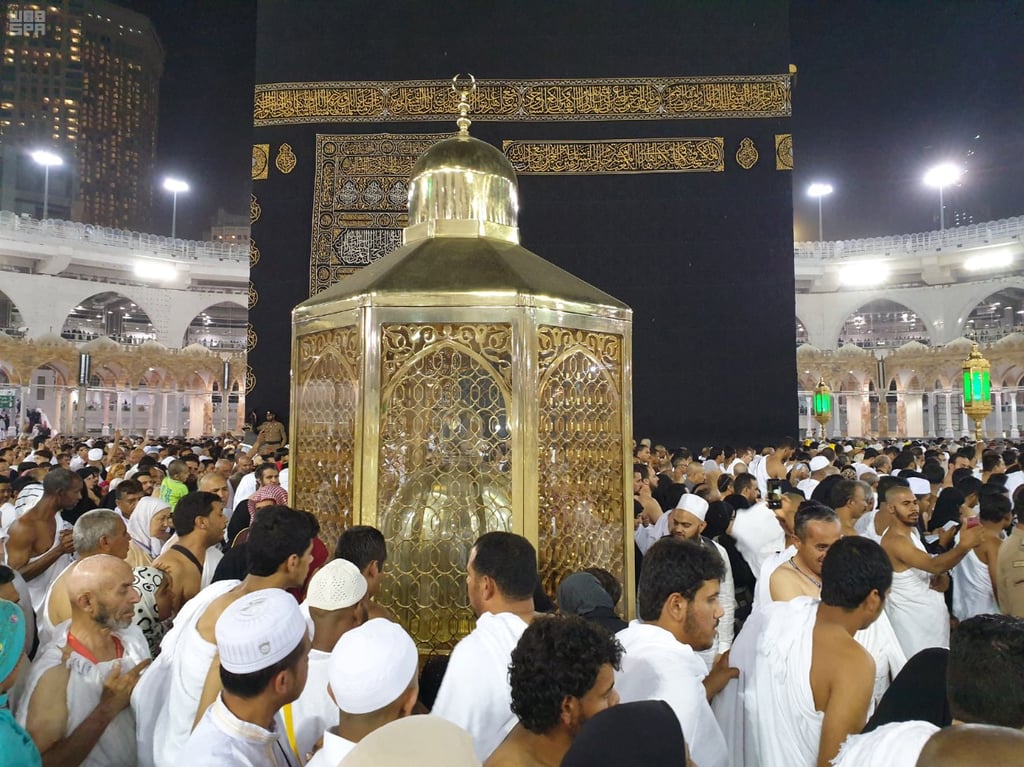
Whenever the months of Hajj approach us—of which Allah said: "Hajj is [during] well-known months" [Al-Baqarah: 197] —we remember the biography of the Father of the Prophets, Abraham (peace be upon him and upon our Prophet). We learn many lessons, morals, and benefits from his noble life story as narrated to us by the Holy Quran.
Among these lessons is "Ihsan" (spiritual excellence/perfection). It means that every person strives for excellence in executing the duties and deeds entrusted to them by Allah. The Prophets (peace be upon them) are humanity’s role models in Islam, Iman (faith), and Ihsan, just as they are role models in all forms of goodness. As Allah the Almighty said in Surah Al-An'am: "Those are the ones whom Allah has guided, so from their guidance take an example." [Al-An'am: 90]
Manifestations of Ihsan in the Life of Prophet Abraham (PBUH)
1. Excellence in Calling to Allah and His Monotheism
He called people to worship Allah alone and avoid associating partners with Him, even though it cost him being thrown into the fire, from which Allah saved him, delivering him from all distress.
2. Excellence in Submission (Islam)
He submitted his whole being to Allah, purifying his heart from everything other than Him, dedicating his heart sincerely to Allah’s call, and demonstrating his readiness to sacrifice his life and everything he owned for the sake of his Almighty Lord’s pleasure. Allah the Almighty said of him: "And indeed, among his kind was Abraham, * When he came to his Lord with a sound heart." [As-Saffat: 83-84]
3. Excellence in Swift and Reassured Compliance
He obeyed Allah's commands immediately, even when those commands were incredibly difficult for the human soul. Examples include relocating his wife, Hagar, and his infant son, Isma‘eel, to the barren mountains of Mecca—where there were no signs of life at the time—and his faithful fulfillment of the vision he saw of sacrificing his only son, Isma‘eel (peace be upon them both).
4. Excellence in Executing the Tasks of Building the Sacred House (The Kaaba)
This excellence manifested clearly in the tasks Allah entrusted to him, including:
Raising the foundations of the House: As Allah the Almighty said:
"And [mention] when Abraham was raising the foundations of the House and [with him] Ishmael, [saying], 'Our Lord, accept [this] from us. Indeed You are the Hearing, the Knowing.'" [Al-Baqarah: 127]
Purifying the House: As Allah the Almighty said:
"And We charged Abraham and Ishmael, [saying], 'Purify My House for those who perform Tawaf and those who are staying [there] for devotion and those who bow and prostrate [in prayer].'" [Al-Baqarah: 125]
Proclaiming the Hajj (Pilgrimage): Even though no one was around to hear him at that time, Allah conveyed his call to the worlds and caused the hearts of believers in every era to yearn to visit and perform pilgrimage to the Sacred House of Allah. As Allah the Almighty said:
"And proclaim to the people the Hajj [pilgrimage]; they will come to you on foot and on every lean camel; they will come from every distant pass -" [Al-Hajj: 22:27]
(O Allah, grant us the pilgrimage to Your Sacred House).
The Ultimate Model of Perfection
Thus, the life of Prophet Abraham (peace be upon him) was a living model of Ihsan at its highest level, both in his worship of the Creator (Glorified and Exalted be He) and in his dealings with creation. It manifested in its most beautiful form through his worship of Allah as if he saw Him, and by offering his soul, wealth, and child in obedience to the Most Merciful.
His Ihsan was also evident in his gentle and kind approach when calling his father to the truth, his extraordinary generosity with his guests, and his absolute submission to Allah’s command. This earned him the status of being a nation obedient to Allah and a leader for humanity. Allah the Almighty described him by saying: "Indeed, We thus reward the doers of good." [As-Saffat: 105] and: "And [of] Abraham, who fulfilled [his obligations]?" [An-Najm: 37]
The meaning of "Abraham, who fulfilled [his obligations]" is that Abraham (peace be upon him) completed all the commands and trials entrusted to him by Allah in the most perfect manner, thereby earning the descriptions of "fulfillment" and "excellence (Ihsan)."
Indeed, Ihsan in the life of Prophet Abraham was defined by a swift and reassured response to fulfilling Allah's will. Prophet Abraham taught us through his fragrant biography that the true Muhsin (doer of excellence) is the one who views Allah’s commands with contentment and certainty—even if they appear difficult on the surface. He taught us that a swift response to Allah’s command brings salvation, even if people think it leads to destruction, and that obedience to Allah is the shortest path to attaining His peace, mercy, and blessings.
"Is the reward for good [anything] but good?" [Ar-Rahman: 60]
The reward for the Ihsan (excellence) of our Master Abraham—in his deeds, his words, his spiritual states, and his fulfillment of everything Allah entrusted him with—was that Allah bestowed His divine favor upon him and made him a beacon of goodness.
Thus, Allah took him as an intimate friend (Khalil), made him a leader for the people, blessed him in his progeny, and placed in his descendants prophethood and scripture. He made him one of the Messengers of Firm Resolve (Ulu al-'Azm), honored him with the building of His Sacred House, and mentioned his story abundantly in the Holy Quran.
Furthermore, Allah granted him a reputation of honor among later generations. His remembrance became eternal through the Abrahamic Prayer (As-Salat Ul-Ibrahimiyyah), which the tongues of believers repeat in every single prayer. Ultimately, Allah gave him his reward in this world, and indeed, in the Hereafter, he is among the righteous.
Learn
Explore the Qur'an and Islamic sciences online.
Connect
Join Our Community
info@quranandlife.net
+20 1113304698
Copyright © 2024 Quran and life